Advanced Search
Turn off MathJax
Article Contents
FANG Juan, LI Jiabao. Communication-Efficient Adaptive Federated Split Learning Optimization Method in Edge Intelligence Scenarios[J]. Journal of Electronics & Information Technology. doi: 10.11999/JEIT260260
Citation: FANG Juan, LI Jiabao. Communication-Efficient Adaptive Federated Split Learning Optimization Method in Edge Intelligence Scenarios[J]. Journal of Electronics & Information Technology. doi: 10.11999/JEIT260260

Communication-Efficient Adaptive Federated Split Learning Optimization Method in Edge Intelligence Scenarios

doi: 10.11999/JEIT260260 cstr: 32379.14.JEIT260260
Funds:  The National Natural Science Foundation of China (61202076), Beijing Natural Science Foundation (4262021)
  • Received Date: 2026-03-09
  • Accepted Date: 2026-10-16
  • Rev Recd Date: 2026-10-13
  • Available Online: 2026-10-25
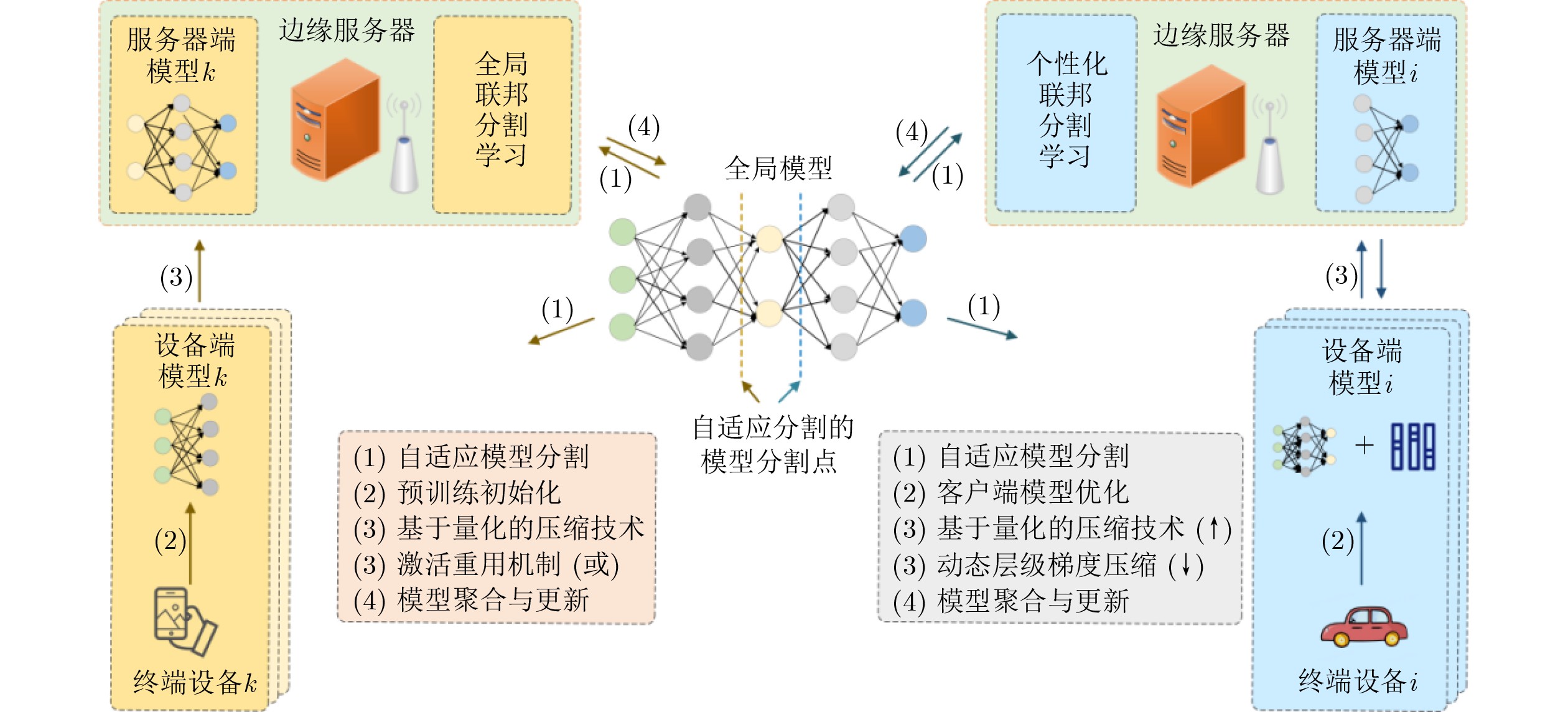
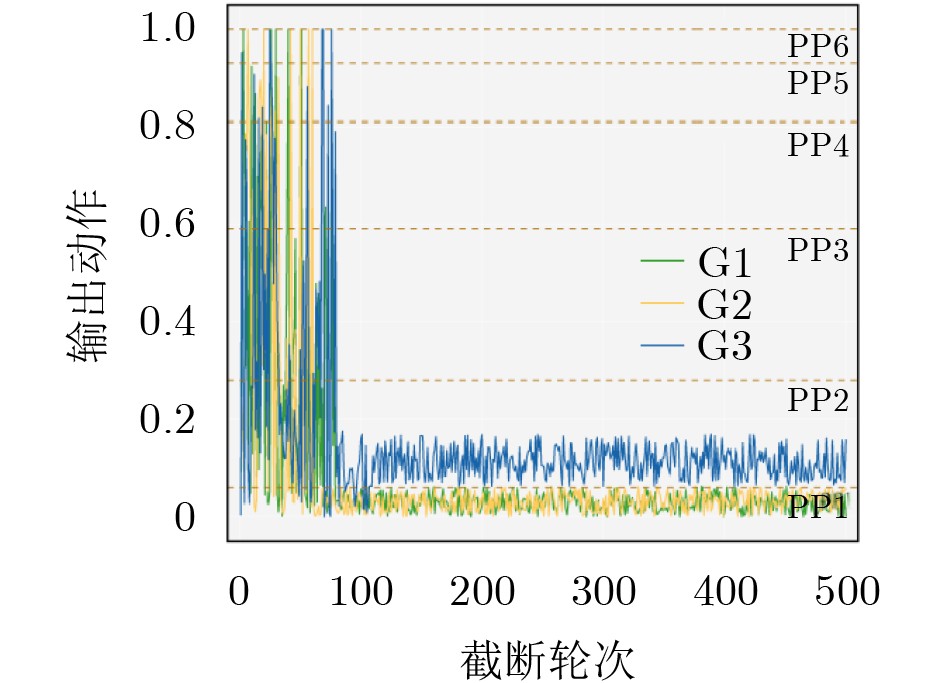
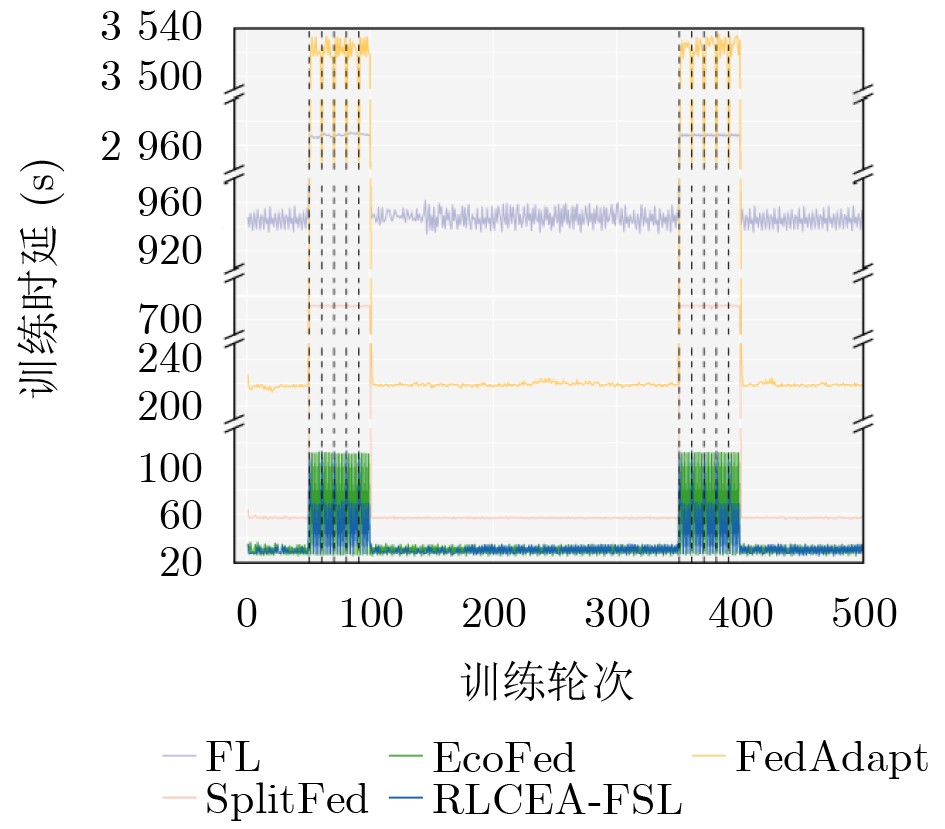
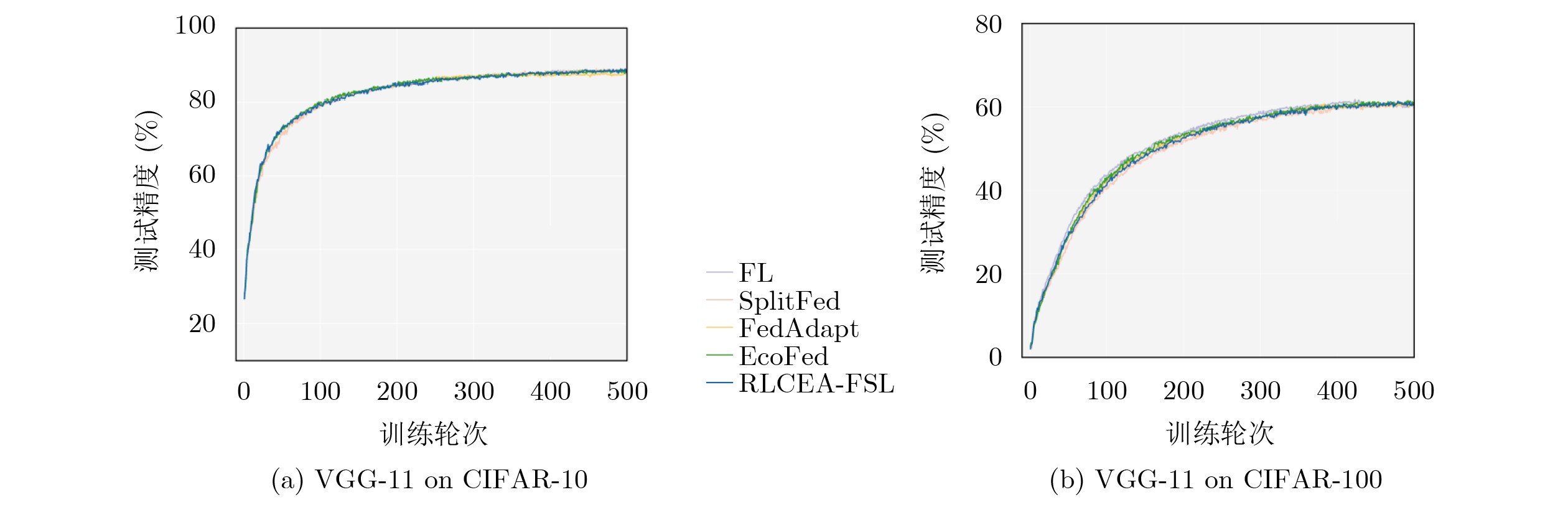
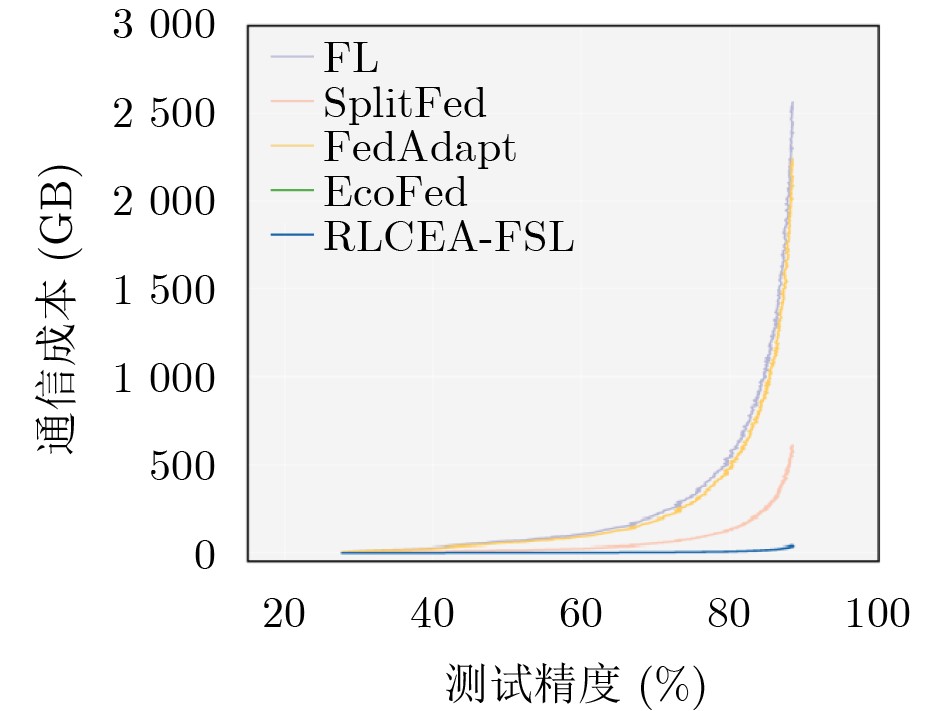
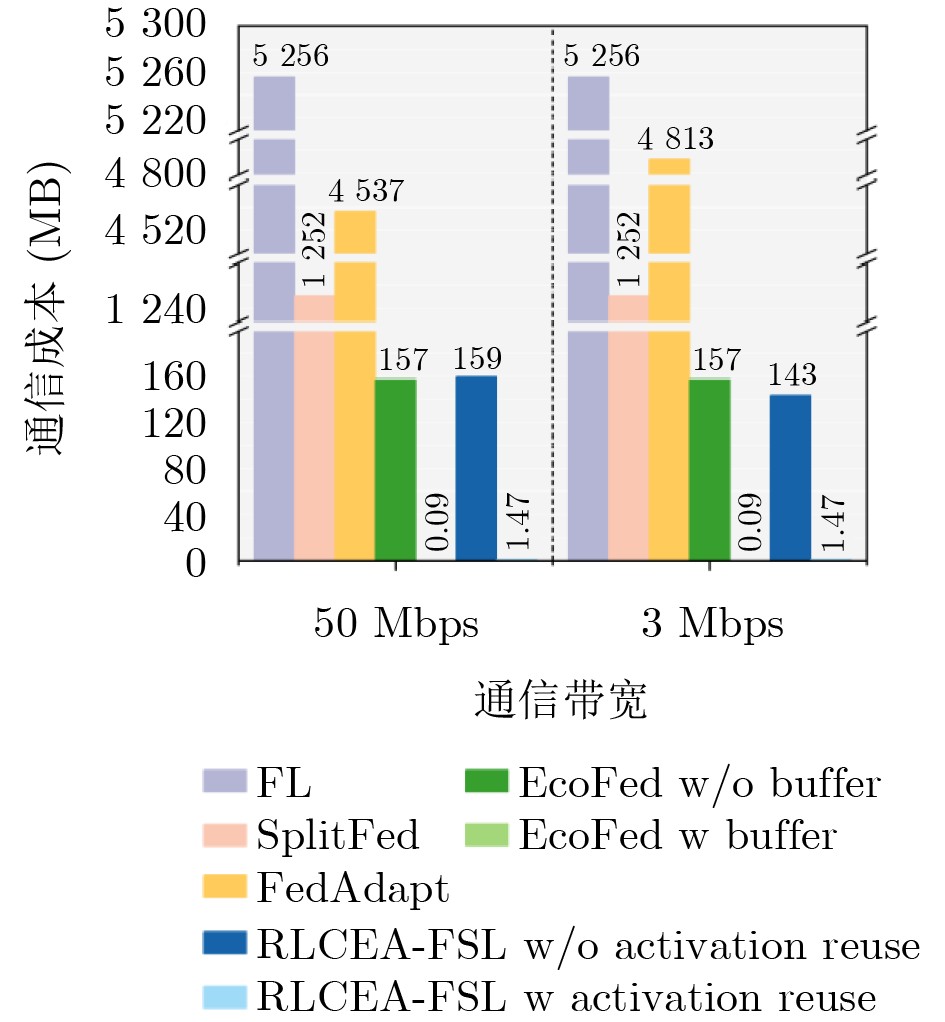
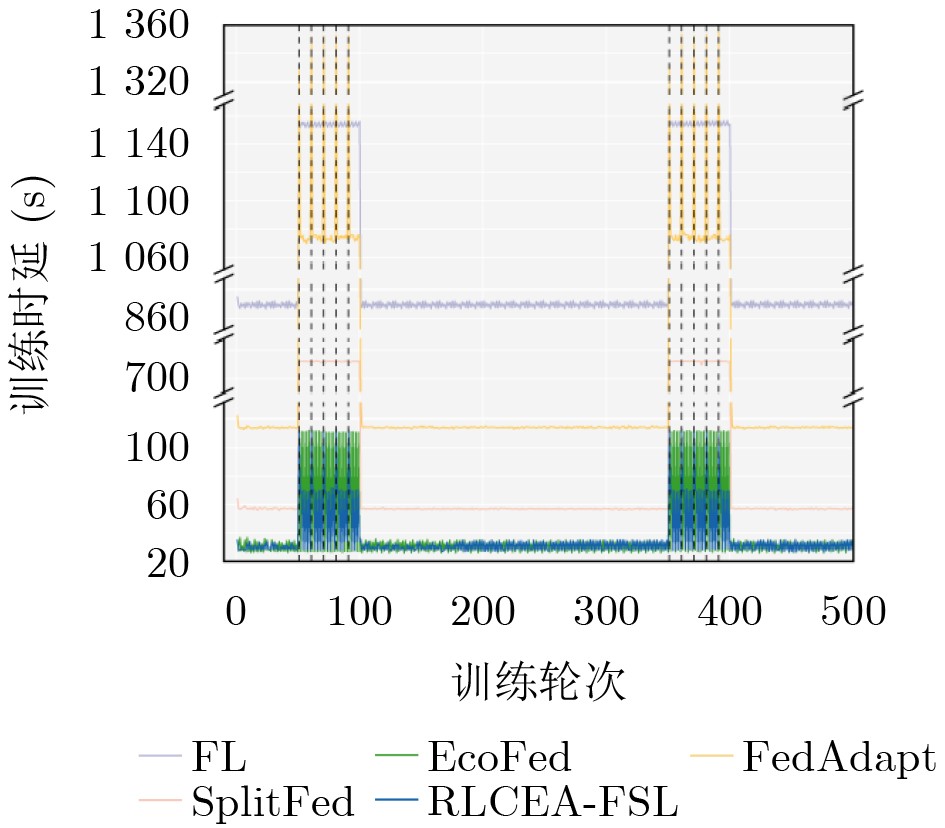
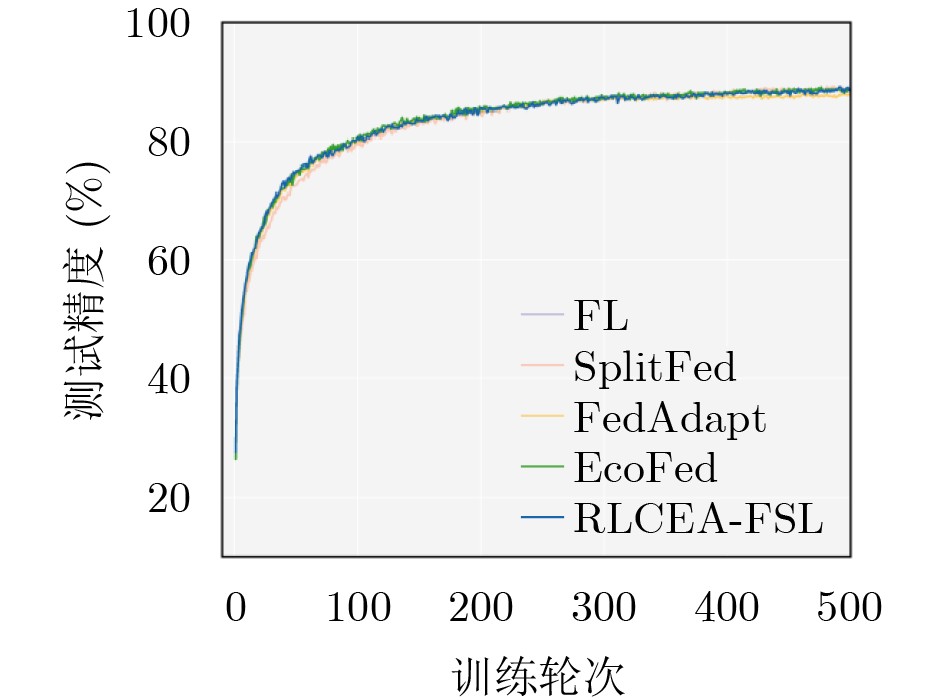
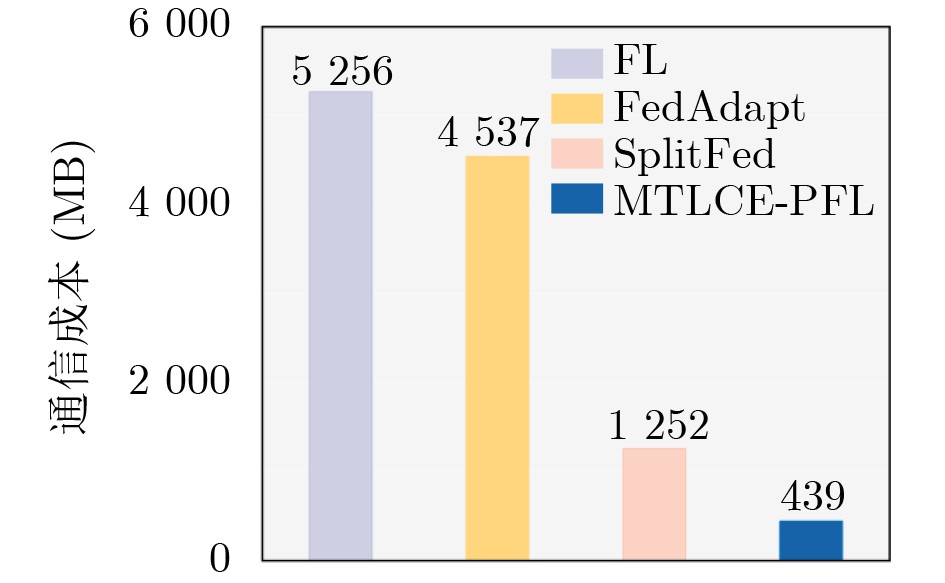
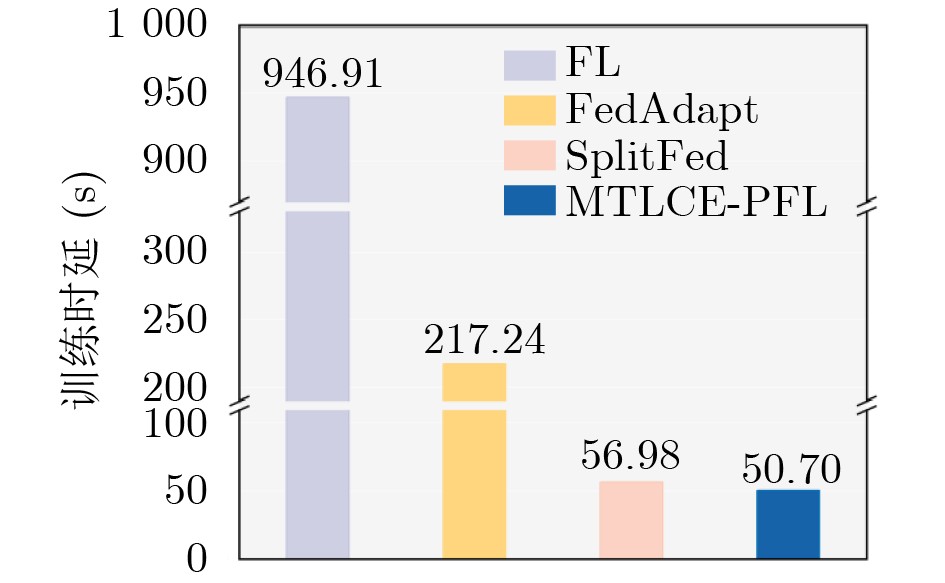
  •   Objective  Federated Split Learning (FSL) has emerged as a promising paradigm for Edge Intelligence (EI) scenarios. By partitioning neural networks, FSL enables collaborative training while alleviating resource constraints on terminal devices. However, frequent interactions between devices and edge servers create high communication overhead, and existing FSL methods have limited adaptability to dynamic network environments. These challenges restrict deployment efficiency. In addition, data heterogeneity in practical edge environments can degrade personalized model performance, while existing studies have not jointly optimized personalized test accuracy and communication efficiency. This study addresses these challenges by integrating Reinforcement Learning (RL), multi-strategy communication optimization, and multi-task learning to adapt to network bandwidth variations, reduce communication overhead, and improve personalized test accuracy.  Methods  This study proposes a communication-efficient adaptive FSL framework that integrates RL-based adaptive model splitting, multi-strategy communication optimization, and multi-task learning-based personalization. First, the Reinforcement Learning-based Communication-Efficient Adaptive Federated Split Learning (RLCEA-FSL) algorithm is proposed to adjust model partition points adaptively in response to network bandwidth variations and reduce communication overhead between end devices and edge servers through multiple communication optimization strategies. Second, the Multi-Task Learning-based Communication-Efficient Personalized Federated Learning (MTLCE-PFL) algorithm is proposed to address the joint optimization of personalized test accuracy and communication efficiency under Non-Independent and Identically Distributed (Non-IID) data distributions. Specifically, batch normalization layers serve as private personalized layers to adapt models to local data distributions, thereby formulating the Non-IID setting as a multi-task learning problem. Additionally, quantization-based compression is applied to intermediate activations transmitted from devices to servers, while dynamic hierarchical gradient compression based on Compressed Sensing (CS) is used to reduce the communication overhead of gradient transmission from servers to devices.  Results and Discussions  The proposed framework and algorithms are evaluated on the CIFAR-10 and CIFAR-100 datasets using VGG-11 and ResNet-9 models. Four baseline methods are considered: classical Federated Learning (FL), SplitFed, FedAdapt, and EcoFed. With activation reuse enabled, RLCEA-FSL (Algorithm 1) achieves speedups of up to 101.23×, 24.27×, and 117.61× compared with FL, SplitFed, and FedAdapt, respectively. Without activation reuse, it reduces average per-round training time by 37.91% compared with EcoFed (Fig. 3). Under bandwidth-constrained conditions, RLCEA-FSL reduces overall communication overhead by 72.75×, 17.33×, and 66.62× compared with FL, SplitFed, and FedAdapt, respectively, and by 8.1% compared with EcoFed (Fig. 6). These improvements result from the adaptive model-splitting strategy, which adjusts partition points in response to bandwidth variations, combined with multiple communication optimization strategies. The RL agent trained on VGG-11 can also be applied directly to ResNet-9 without retraining, yielding favorable results in training latency, test accuracy, and communication overhead (Figs. 7 and 8). MTLCE-PFL improves personalized test accuracy under Non-IID data distributions while reducing communication overhead and training latency. Compared with the other algorithms, MTLCE-PFL (Algorithm 2) achieves faster convergence and higher personalized test accuracy on both CIFAR-10 and CIFAR-100 with both VGG-11 and ResNet-9 (Fig. 9). These improvements result from the multi-task learning framework and private personalized layers, which adapt to local data distributions and enable client-specific optimization. In terms of communication efficiency, MTLCE-PFL reduces bidirectional communication overhead by 11.97×, 2.86×, and 10.33× compared with FL, SplitFed, and FedAdapt, respectively, through quantization-based compression of intermediate activations and dynamic hierarchical CS-based compression of gradients transmitted back to devices (Fig. 10). Despite the additional computational complexity introduced by personalized layers, MTLCE-PFL reduces average per-round training time by 11.02% compared with SplitFed and achieves speedups of 4.28× and 18.68× over FedAdapt and FL, respectively (Fig. 11). These results demonstrate the effectiveness of the proposed methods in maintaining global model accuracy while improving personalized test accuracy and reducing communication overhead and training latency.  Conclusions  The proposed communication-efficient adaptive FSL framework addresses high communication overhead, dynamic network conditions, and data heterogeneity in EI scenarios through complementary optimization strategies. RLCEA-FSL combines RL-based adaptive model splitting with communication optimization to respond to bandwidth variations and reduce training latency and communication overhead while maintaining global model accuracy comparable to that of the baseline methods. The direct application of the RL agent trained on VGG-11 to ResNet-9 without retraining suggests potential deployment flexibility; however, further experiments are needed to establish robust cross-model generalization. MTLCE-PFL combines multi-task learning with private personalized layers to improve personalized test accuracy under Non-IID data distributions while reducing bidirectional communication overhead through quantization-based activation compression and dynamic hierarchical CS-based gradient compression.
  • loading
  • [1]
    CHEN Bin, HUANG Yujun, QIU Han, et al. Image compression for resource-constrained AIoT system with compressed sensing[J]. IEEE Transactions on Systems, Man, and Cybernetics: Systems, 2025, 55(8): 5464–5476. doi: 10.1109/TSMC.2025.3571480.
    [2]
    FANG Juan, QU Dezheng, CHEN Huijie, et al. Dependency-aware dynamic task offloading based on deep reinforcement learning in mobile-edge computing[J]. IEEE Transactions on Network and Service Management, 2024, 21(2): 1403–1415. doi: 10.1109/TNSM.2023.3319294.
    [3]
    曹绍华, 陈辉, 陈舒, 等. AccFed: 物联网中基于模型分割的联邦学习加速[J]. 电子与信息学报, 2023, 45(5): 1678–1687. doi: 10.11999/JEIT220240.

    CAO Shaohua, CHEN Hui, CHEN Shu, et al. AccFed: Federated learning acceleration based on model partitioning in internet of things[J]. Journal of Electronics & Information Technology, 2023, 45(5): 1678–1687. doi: 10.11999/JEIT220240.
    [4]
    TENG Ziyi, FANG Juan, YANG Huijing, et al. Attention mechanism-aided deep reinforcement learning for dynamic edge caching[J]. IEEE Internet of Things Journal, 2024, 11(6): 10197–10213. doi: 10.1109/JIOT.2023.3327656.
    [5]
    YAN Guozhi, LIU Kai, LIU Chunhui, et al. Edge intelligence for internet of vehicles: A survey[J]. IEEE Transactions on Consumer Electronics, 2024, 70(2): 4858–4877. doi: 10.1109/TCE.2024.3378509.
    [6]
    宁博, 宁一鸣, 杨超, 等. 自适应聚类中心个数选择: 一种联邦学习的隐私效用平衡方法[J]. 电子与信息学报, 2025, 47(2): 519–529. doi: 10.11999/JEIT240414.

    NING Bo, NING Yiming, YANG Chao, et al. Adaptive clustering center selection: A privacy utility balancing method for federated learning[J]. Journal of Electronics & Information Technology, 2025, 47(2): 519–529. doi: 10.11999/JEIT240414.
    [7]
    THAPA C, MAHAWAGA ARACHCHIGE P C, CAMTEPE S, et al. SplitFed: When federated learning meets split learning[C]. The 36th AAAI Conference on Artificial Intelligence, Vancouver, Canada, 2022: 8485–8493. doi: 10.1609/aaai.v36i8.20825.
    [8]
    NI Wanli, AO Huiqing, TIAN Hui, et al. FedSL: Federated split learning for collaborative healthcare analytics on resource-constrained wearable IoMT devices[J]. IEEE Internet of Things Journal, 2024, 11(10): 18934–18935. doi: 10.1109/JIOT.2024.3370985.
    [9]
    唐伦, 汪智平, 蒲昊, 等. 基于自适应梯度压缩的高效联邦学习通信机制研究[J]. 电子与信息学报, 2023, 45(1): 227–234. doi: 10.11999/JEIT211262.

    TANG Lun, WANG Zhiping, PU Hao, et al. Research on efficient federated learning communication mechanism based on adaptive gradient compression[J]. Journal of Electronics & Information Technology, 2023, 45(1): 227–234. doi: 10.11999/JEIT211262.
    [10]
    WU Di, ULLAH R, RODGERS P, et al. EcoFed: Efficient communication for DNN partitioning-based federated learning[J]. IEEE Transactions on Parallel and Distributed Systems, 2024, 35(3): 377–390. doi: 10.1109/TPDS.2024.3349617.
    [11]
    YAN Maoxuan, LUO Qingcai, ZHANG Bo, et al. Solving client dropout in federated learning via client similarity discovery and gradient supplementation mechanism[C]. 23rd International Conference Algorithms and Architectures for Parallel Processing, Tianjin, China, 2023: 446–457. doi: 10.1007/978-981-97-0808-6_26.
    [12]
    WU Di, ULLAH R, HARVEY P, et al. FedAdapt: Adaptive offloading for IoT devices in federated learning[J]. IEEE Internet of Things Journal, 2022, 9(21): 20889–20901. doi: 10.1109/JIOT.2022.3176469.
    [13]
    CHOUGULE S B, CHAUDHARI B S, GHORPADE S N, et al. Exploring computing paradigms for electric vehicles: From cloud to edge intelligence, challenges and future directions[J]. World Electric Vehicle Journal, 2024, 15(2): 39. doi: 10.3390/wevj15020039.
    [14]
    何帆, 王勇, 杨静, 等. 面向边缘计算场景的个性化联邦学习综述[J]. 通信学报, 2025, 46(7): 206–225. doi: 10.11959/j.issn.1000-436x.2025131.

    HE Fan, WANG Yong, YANG Jing, et al. Survey of personalized federated learning for edge computing scenarios[J]. Journal on Communications, 2025, 46(7): 206–225. doi: 10.11959/j.issn.1000-436x.2025131.
    [15]
    汪永好, 肖峰, 万弘友. 个性化联邦学习算法综述[J]. 计算机技术与发展, 2026, 36(2): 1–9. doi: 10.20165/j.cnki.ISSN1673-629X.2025.0245.

    WANG Yonghao, XIAO Feng, and WAN Hongyou. Review of personalized federated learning algorithms[J]. Computer Technology and Development, 2026, 36(2): 1–9. doi: 10.20165/j.cnki.ISSN1673-629X.2025.0245.
    [16]
    MILLS J, HU Jia, and MIN Geyong. Multi-task federated learning for personalised deep neural networks in edge computing[J]. IEEE Transactions on Parallel and Distributed Systems, 2022, 33(3): 630–641. doi: 10.1109/TPDS.2021.3098467.
    [17]
    ALOTAIBI B K, KHAN F A, QAWQZEH Y, et al. Performance and communication cost of deep neural networks in federated learning environments: An empirical study[J]. International Journal of Interactive Multimedia and Artificial Intelligence, 2025, 9(4): 6–17. doi: 10.9781/ijimai.2024.12.001.
    [18]
    YUAN Xin, SAVKIN A V, NI Wei, et al. Optimal online control strategy for differentially private federated learning[J]. IEEE Transactions on Dependable and Secure Computing, 2026, 23(2): 4164–4176. doi: 10.1109/TDSC.2025.3643906.
    [19]
    李敏, 肖迪, 陈律君. 兼顾通信效率与效用的自适应高斯差分隐私个性化联邦学习[J]. 计算机学报, 2024, 47(4): 924–946. doi: 10.11897/SP.J.1016.2024.00924.

    LI Min, XIAO Di, and CHEN Lüjun. Communication-efficient and utility-aware adaptive Gaussian differential privacy for personalized federated learning[J]. Chinese Journal of Computers, 2024, 47(4): 924–946. doi: 10.11897/SP.J.1016.2024.00924.
    [20]
    TANG Xiaoli, YU Han, TANG Run, et al. Dual calibration-based personalised federated learning[C]. The Thirty-Third International Joint Conference on Artificial Intelligence, Jeju, Korea, 2024: 551. doi: 10.24963/ijcai.2024/551.
    [21]
    LI Xiaoxiao, JIANG Meirui, ZHANG Xiaofei, et al. FedBN: Federated learning on non-IID features via local batch normalization[C]. 9th International Conference on Learning Representations, Virtual Event, Austria, 2021.
    [22]
    SANNARA E K, PORTET F, LALANDA P, et al. A federated learning aggregation algorithm for pervasive computing: Evaluation and comparison[C]. 2021 IEEE International Conference on Pervasive Computing and Communications (PerCom), Kassel, Germany, 2021: 1–10. doi: 10.1109/PERCOM50583.2021.9439129.
    [23]
    DINH C T, TRAN N H, and NGUYEN J D. Personalized federated learning with moreau envelopes[C]. The 34th International Conference on Neural Information Processing Systems, Vancouver, Canada, 2020: 1796.
  • 加载中

Catalog

    通讯作者: 陈斌, bchen63@163.com
    • 1. 

      沈阳化工大学材料科学与工程学院 沈阳 110142

    1. 本站搜索
    2. 百度学术搜索
    3. 万方数据库搜索
    4. CNKI搜索

    Figures(11)  / Tables(5)

    Article Metrics

    Article views (108) PDF downloads(17) Cited by()
    Proportional views
    Related

    /

    DownLoad:  Full-Size Img  PowerPoint
    Return
    Return