Advanced Search
Turn off MathJax
Article Contents
LIU Genggeng, JIAO Xinyue, PAN Youlin, HUANG Xing. One-pass Architectural Synthesis for Continuous-Flow Microfluidic Biochips Based on Deep Reinforcement Learning[J]. Journal of Electronics & Information Technology. doi: 10.11999/JEIT251058
Citation: LIU Genggeng, JIAO Xinyue, PAN Youlin, HUANG Xing. One-pass Architectural Synthesis for Continuous-Flow Microfluidic Biochips Based on Deep Reinforcement Learning[J]. Journal of Electronics & Information Technology. doi: 10.11999/JEIT251058

One-pass Architectural Synthesis for Continuous-Flow Microfluidic Biochips Based on Deep Reinforcement Learning

doi: 10.11999/JEIT251058 cstr: 32379.14.JEIT251058
Funds:  The National Natural Science Foundation of China (62372109, 62572396), Fujian Science Fund for Distinguished Young Scholars (2023J06017)
  • Received Date: 2025-10-09
  • Accepted Date: 2025-12-22
  • Rev Recd Date: 2025-12-20
  • Available Online: 2026-01-04
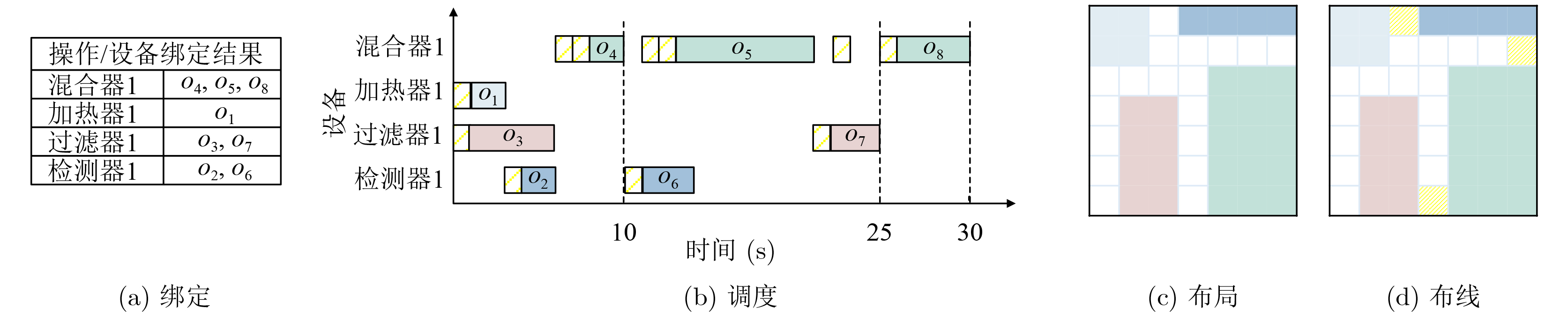
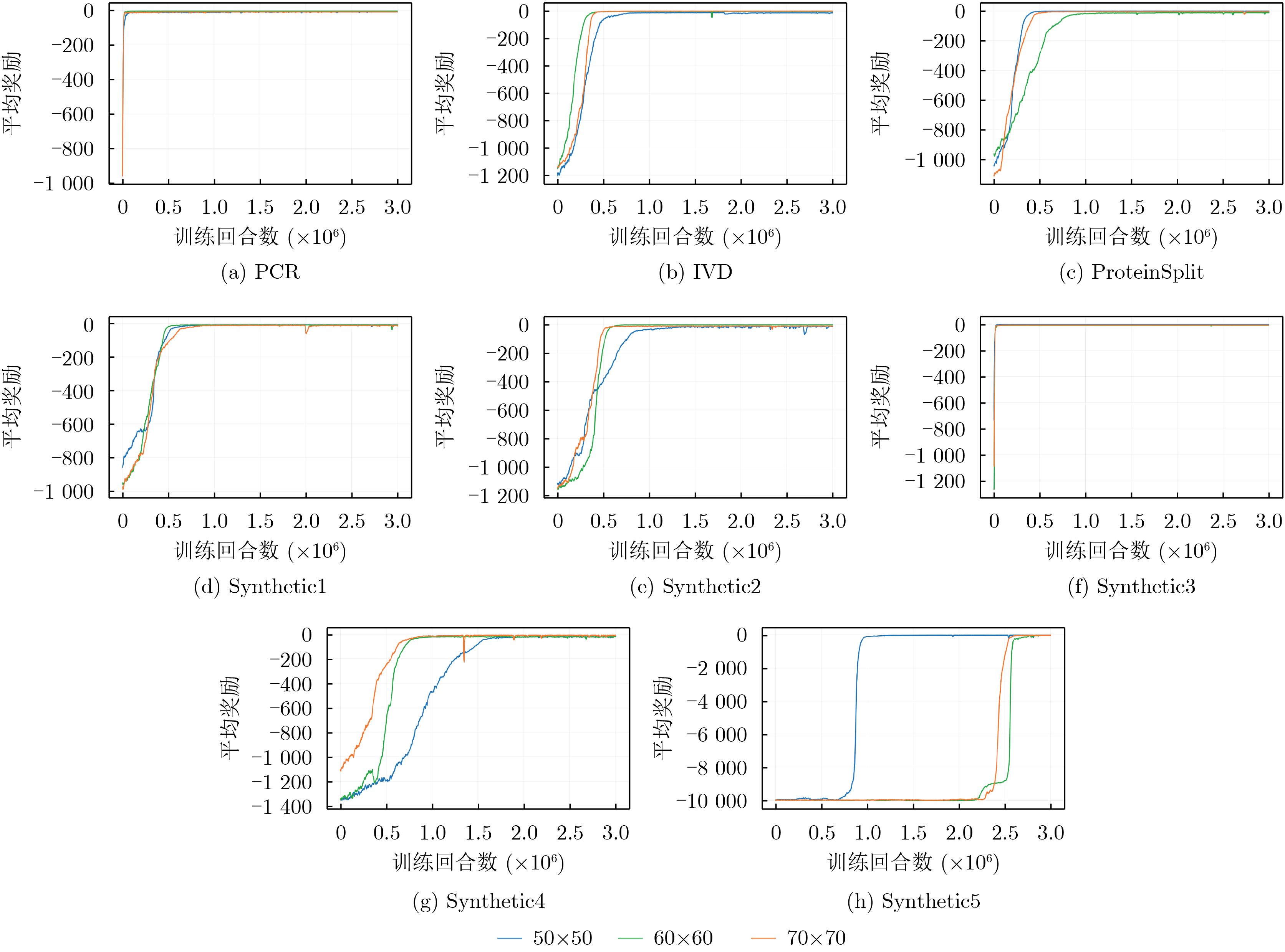
  • Continuous-Flow Microfluidic Biochips (CFMBs) are widely applied in biomedical research because of miniaturization, high reliability, and low sample consumption. As integration density increases, design complexity significantly rises. Conventional stepwise design methods treat binding, scheduling, layout, and routing as separate stages, with limited information exchange across stages, which leads to reduced solution quality and extended design cycles. To address this limitation, a one-pass architectural synthesis method for CFMBs is proposed based on Deep Reinforcement Learning (DRL). Graph Convolutional Neural networks (GCNs) are used to extract state features, capturing structural characteristics of operations and their relationships. Proximal Policy Optimization (PPO), combined with the A* algorithm and list scheduling, ensures rational layout and routing while providing accurate information for operation scheduling. A multiobjective reward function is constructed by normalizing and weighting biochemical reaction time, total channel length, and valve count, enabling efficient exploration of the decision space through policy gradient updates. Experimental results show that the proposed method achieves a 2.1% reduction in biochemical reaction time, a 21.3% reduction in total channel length, and a 65.0% reduction in valve count on benchmark test cases, while maintaining feasibility for larger-scale chips.  Objective  CFMBs have gained sustained attention in biomedical applications because of miniaturization, high reliability, and low sample consumption. With increasing integration density, design complexity escalates substantially. Traditional stepwise design methods often yield suboptimal solutions, extended design cycles, and feasibility limitations for large-scale chips. To address these challenges, a one-pass architectural synthesis framework is proposed that integrates DRL to achieve coordinated optimization of binding, scheduling, layout, and routing.  Methods  All CFMB design tasks are integrated into a unified optimization framework formulated as a Markov decision process. The state space includes device binding information, device locations, operation priorities, and related parameters, whereas the action space adjusts device placement, operation-to-device binding, and operation priority. High-dimensional state features are extracted using GCNs. PPO is applied to iteratively update policies. The reward function accounts for biochemical reaction time, total flow-channel length, and the number of additional valves. These metrics are evaluated using the A* algorithm and list scheduling, normalized, and weighted to balance trade-offs among objectives.  Results and Discussions  Based on the current state and candidate actions, architectural solutions are generated iteratively through PPO-guided policy updates combined with the A* algorithm and list scheduling. The defined reward function enables the generation of CFMB architectures with improved overall quality. Experimental results show an average reduction of 2.1% in biochemical reaction time, an average reduction of 21.3% in total flow-channel length, with a maximum reduction of 57.1% in the ProteinSplit benchmark, and an average reduction of 65.0% in additional valve count compared with existing methods. These improvements reduce manufacturing cost and operational risk.  Conclusions  A one-pass architectural synthesis method for CFMBs based on DRL is proposed to address flow-layer design challenges. By applying GCN-based state feature extraction and PPO-based policy optimization, the multiobjective design problem is transformed into a sequential decision-making process that enables joint optimization of binding, scheduling, layout, and routing. Experimental results obtained from multiple benchmark test cases confirm improved performance in biochemical reaction completion time, total channel length, and valve count, while preserving scalability for larger chip designs.
  • loading
  • [1]
    CONVERY N and GADEGAARD N. 30 years of microfluidics[J]. Micro and Nano Engineering, 2019, 2: 76–91. doi: 10.1016/j.mne.2019.01.003.
    [2]
    CHOU H P, UNGER M A, SCHERER A, et al. Integrated elastomer fluidic lab-on-a-chip-surface patterning and DNA diagnostics[C]. The Solid State Actuator and Sensor Workshop, Hilton Head, South Carolina, 2000: 111–114. doi: 10.31438/trf.hh2000.27.
    [3]
    KINCSES A, VIGH J P, PETROVSZKI D, et al. The use of sensors in blood-brain barrier-on-a-chip devices: Current practice and future directions[J]. Biosensors, 2023, 13(3): 357. doi: 10.3390/bios13030357.
    [4]
    ARACI I E and QUAKE S R. Microfluidic very large scale integration (mVLSI) with integrated micromechanical valves[J]. Lab on a Chip, 2012, 12(16): 2803–2806. doi: 10.1039/c2lc40258k.
    [5]
    TSENG K H, YOU S C, LIOU J Y, et al. A top-down synthesis methodology for flow-based microfluidic biochips considering valve-switching minimization[C]. The 2013 ACM International Symposium on Physical Design, Nevada, USA, 2013: 123–129. doi: 10.1145/2451916.2451948.
    [6]
    陈志盛, 朱予涵, 刘耿耿, 等. 考虑流端口数量约束下的连续微流控生物芯片流路径规划算法[J]. 电子与信息学报, 2023, 45(9): 3321–3330. doi: 10.11999/JEIT221168.

    CHEN Zhisheng, ZHU Yuhan, LIU Genggeng, et al. Flow-path planning algorithm for continuous-flow microfluidic biochips with strictly constrained flow ports[J]. Journal of Electronics & Information Technology, 2023, 45(9): 3321–3330. doi: 10.11999/JEIT221168.
    [7]
    HUANG Huichang, YANG Zhongliao, ZHONG Jiayuan, et al. Genetic-A* algorithm-based routing for continuous-flow microfluidic biochip in intelligent digital healthcare[C]. 18th International Conference on Green, Pervasive, and Cloud Computing, Harbin, China, 2023: 209–223.
    [8]
    KESZOCZE O, WILLE R, HO T Y, et al. Exact one-pass synthesis of digital microfluidic biochips[C]. The 51st ACM/EDAC/IEEE Design Automation Conference, San Francisco, USA, 2014: 1–6. doi: 10.1145/2593069.2593135.
    [9]
    WILLE R, KESZOCZE O, DRECHSLER R, et al. Scalable one-pass synthesis for digital microfluidic biochips[J]. IEEE Design & Test, 2015, 32(6): 41–50. doi: 10.1109/MDAT.2015.2455344.
    [10]
    MOHAMMADZADEH N, WILLE R, and KESZOCZE O. Efficient one-pass synthesis for digital microfluidic biochips[J]. ACM Transactions on Design Automation of Electronic Systems (TODAES), 2021, 26(4): 27. doi: 10.1145/3446880.
    [11]
    HUANG Xing, PAN Youlin, CHEN Zhen, et al. BigIntegr: One-pass architectural synthesis for continuous-flow microfluidic lab-on-a-chip systems[C]. 2021 IEEE/ACM International Conference on Computer Aided Design, Munich, Germany, 2021: 1–8. doi: 10.1109/ICCAD51958.2021.9643576.
    [12]
    HUANG Xing, PAN Youlin, CHEN Zhen, et al. Design automation for continuous-flow lab-on-a-chip systems: A one-pass paradigm[J]. IEEE Transactions on Computer-Aided Design of Integrated Circuits and Systems, 2023, 42(1): 327–331. doi: 10.1109/TCAD.2022.3166105.
    [13]
    MIRHOSEINI A, GOLDIE A, YAZGAN M, et al. A graph placement methodology for fast chip design[J]. Nature, 2021, 594(7862): 207–212. doi: 10.1038/s41586-021-03544-w.
    [14]
    蔡华洋, 黄兴, 刘耿耿. 基于深度强化学习的连续微流控生物芯片控制逻辑布线[J]. 计算机研究与发展, 2025, 62(4): 950–962. doi: 10.7544/issn1000-1239.202440034.

    CAI Huayang, HUANG Xing, and LIU Genggeng. Control logic routing for continuous-flow microfluidic biochips based on deep reinforcement learning[J]. Journal of Computer Research and Development, 2025, 62(4): 950–962. doi: 10.7544/issn1000-1239.202440034.
    [15]
    KAWAKAMI T, SHIRO C, NISHIKAWA H, et al. A deep reinforcement learning approach to droplet routing for erroneous digital microfluidic biochips[J]. Sensors, 2023, 23(21): 8924. doi: 10.3390/s23218924.
    [16]
    LIM Y C, KOUZANI A Z, and DUAN W. Lab-on-a-chip: A component view[J]. Microsystem Technologies, 2010, 16(12): 1995–2015. doi: 10.1007/s00542-010-1141-6.
  • 加载中

Catalog

    通讯作者: 陈斌, bchen63@163.com
    • 1. 

      沈阳化工大学材料科学与工程学院 沈阳 110142

    1. 本站搜索
    2. 百度学术搜索
    3. 万方数据库搜索
    4. CNKI搜索

    Figures(6)  / Tables(5)

    Article Metrics

    Article views (100) PDF downloads(17) Cited by()
    Proportional views
    Related

    /

    DownLoad:  Full-Size Img  PowerPoint
    Return
    Return